FROSTlines
Advances in Compressor-Free Cooling
Researchers have developed a new refrigeration technology with nano-engineered materials
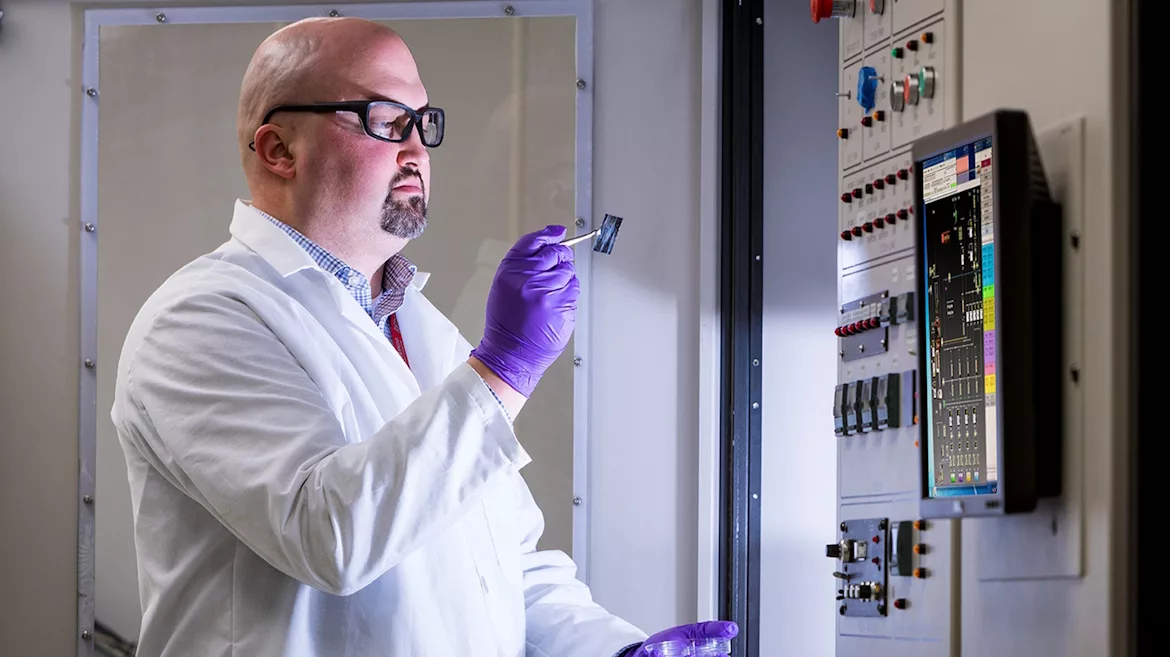
NEW MATERIALS: Jon Pierce, a senior research engineer at APL, examines a thin film grown using metal-organic chemical vapor deposition, a method well known for its scalability and cost-effectiveness. (Courtesy, Johns Hopkins APL/Ed Whitman)
Researchers at the Johns Hopkins Applied Physics Laboratory (APL) in Laurel, Maryland, have developed a new, easily manufacturable, solid-state, thermoelectric refrigeration technology with nano-engineered materials that is twice as efficient as devices made with commercially available bulk thermoelectric materials. As global demand grows for more energy-efficient, reliable, and compact cooling solutions, this advancement offers a scalable alternative to traditional compressor-based refrigeration.
In a recently published paper in Nature Communications, a team of researchers from APL and refrigeration engineers from Samsung Research demonstrated improved heat-pumping efficiency and capacity in refrigeration systems attributable to high-performance, nano-engineered, thermoelectric materials invented at APL known as controlled hierarchically engineered superlattice structures (CHESS).
The CHESS technology is the result of 10 years of APL research in advanced nano-engineered thermoelectric materials and applications development. Initially developed for national security applications, the material has also been used for noninvasive cooling therapies for prosthetics and won an R&D 100 award in 2023.
“This real-world demonstration of refrigeration using new thermoelectric materials showcases the capabilities of nano-engineered CHESS thin films,” said Rama Venkatasubramanian, principal investigator of the joint project and chief technologist for thermoelectrics at APL. “It marks a significant leap in cooling technology and sets the stage for translating advances in thermoelectric materials into practical, large-scale, energy-efficient refrigeration applications.”
New Benchmark
The push for more efficient and compact cooling technologies is fueled by a variety of factors, including population growth, urbanization, and an increasing reliance on advanced electronics and data infrastructure. Conventional cooling systems, while effective, are often bulky, energy-intensive, and reliant on chemical refrigerants that can be harmful to the environment.
Thermoelectric refrigeration is widely regarded as a potential solution. This method cools by using electrons to move heat through specialized semiconductor materials, eliminating the need for moving parts or harmful chemicals, making these next-generation refrigerators quiet, compact, reliable, and sustainable. Bulk thermoelectric materials are used in small devices like mini-fridges, but their limited efficiency, low heat-pumping capacity, and incompatibility with scalable semiconductor chip fabrication have historically prevented their wider use in high-performance systems.
In the study, researchers compared refrigeration modules using traditional bulk thermoelectric materials with those using CHESS thin-film materials in standardized refrigeration tests, measuring and comparing the electrical power needed to achieve various cooling levels in the same commercial refrigerator test systems. The refrigeration team from Samsung Research’s Life Solution Team, led by executive vice president Joonhyun Lee, collaborated with APL to validate the results through detailed thermal modeling, quantifying heat loads and thermal resistance parameters to ensure accurate performance evaluation under real-world conditions.
Looking for quick answers on air conditioning, heating and refrigeration topics? Try Ask ACHR NEWS, our new smart AI search tool. Ask ACHR NEWS
The results were striking: using CHESS materials, the APL team achieved nearly 100% improvement in efficiency over traditional thermoelectric materials at room temperature (around 80°F). They then translated these material-level gains into a near 75% improvement in efficiency at the device level in thermoelectric modules built with CHESS materials and a 70% improvement in efficiency in a fully integrated refrigeration system, each representing a significant improvement over state-of-the-art bulk thermoelectric devices. These tests were completed under conditions that involved significant amounts of heat pumping to replicate practical operation.
Built To Scale
Beyond improving efficiency, the CHESS thin-film technology uses remarkably less material -- just 0.003 cubic centimeters, or about the size of a grain of sand -- per refrigeration unit. This reduction in material means APL’s thermoelectric materials could be mass-produced using semiconductor chip production tools, driving cost efficiency and enabling widespread market adoption.
“This thin-film technology has the potential to grow from powering small-scale refrigeration systems to supporting large building HVAC applications, similar to the way lithium-ion batteries have been scaled to power devices as small as mobile phones and as large as electric vehicles,” said Venkatasubramanian.
Additionally, the CHESS materials were created using a well-established process commonly used to manufacture high-efficiency solar cells that power satellites and commercial LED lights.
“We used metal-organic chemical vapor deposition (MOCVD) to produce the CHESS materials, a method well known for its scalability, cost-effectiveness, and ability to support large-volume manufacturing,” said Jon Pierce, a senior research engineer who leads the MOCVD growth capability at APL. “MOCVD is already widely used commercially, making it ideal for scaling up CHESS thin-film thermoelectric materials production.”
These materials and devices continue to show promise for a broad range of energy-harvesting and electronics applications in addition to the recent advances in refrigeration. APL plans to continue to partner with organizations to refine the CHESS thermoelectric materials with a focus on boosting efficiency to approach that of conventional mechanical systems. Future efforts include demonstrating larger-scale refrigeration systems, including freezers, and integrating AI-driven methods to optimize energy efficiency in compartmentalized or distributed cooling in refrigeration and HVAC equipment.
“Beyond refrigeration, CHESS materials are also able to convert temperature differences, like body heat, into usable power,” said Jeff Maranchi, exploration program area manager in APL’s research and exploratory development mission area. “In addition to advancing next-generation tactile systems, prosthetics, and human-machine interfaces, this opens the door to scalable energy-harvesting technologies for applications ranging from computers to spacecraft -- capabilities that weren’t feasible with older, bulkier thermoelectric devices.”
“The success of this collaborative effort demonstrates that high-efficiency solid-state refrigeration is not only scientifically viable but manufacturable at scale,” said Susan Ehrlich, technology commercialization manager at APL. “We’re looking forward to continued research and technology transfer opportunities with companies as we work toward translating these innovations into practical, real-world applications.”
This article was republished with permission from https://www.jhuapl.edu/news/news-releases/250521-apl-thermoelectrics-enable-compressor-free-cooling
Looking for a reprint of this article?
From high-res PDFs to custom plaques, order your copy today!